


















EVERFI Alternatives for High School Financial Literacy
When EVERFI launched, there was very little personal finance curriculum available, and they pioneered a model where banks and corporations paid to make financial literacy modules free to schools. It led to a huge compliance win and helped satisfy standards for early-adopting states, but left a lot on the table regarding student engagement.
The lessons are professionally produced, the platform is stable, and there's no cost to the district, but you get what you pay for. The self-guided modules can feel passive, and students click through content without really doing anything. Teachers want hands-on, real-world practice, especially with investing, and the curriculum only offers a few, click-through style games.
This guide walks through five EVERFI alternatives for high school in 2026: what each one is good at, and who should actually consider it.

What high school teachers actually want
EVERFI covers a lot of ground, so an alternative has to earn its spot. When we help schools compare options, the strongest programs tend to check these five boxes:
- Active learning, not just modules. Students should build, trade, or decide something. Not only read and answer.
- Real investing practice. Investing is a skill, and skills take reps. A simulator that mirrors the real market is what makes the concept stick.
- Standards you can defend. Clear alignment to the CEE pillars and your state requirement, with a crosswalk you can hand to an administrator.
- Equity and access. Spanish availability, screen-reader accessibility, and a design that works on the bandwidth and devices your students really have.
- A reason to come back. Stakes, competition, ownership. Something that keeps students engaged past week one.
Is EVERFI actually free, and what's the catch?
EVERFI's high school financial literacy modules cost nothing to schools because banks, credit unions, and other corporate partners sponsor the content instead of billing districts directly, according to EVERFI's own course page. That sponsor-funded model is useful for a compliance-first rollout: no purchase order, no budget approval, no waiting on a school board vote.
The trade-off shows up in depth, not price. A free library of self-paced modules asks a lot of the teacher, who has to supply the classroom activity, discussion, and follow-through that turns a module into real learning. EVERFI's modules are free to schools because banks and corporations sponsor them; Rapunzl's cost reflects an integrated, hands-on curriculum and live simulator, not just a free lesson library.
Neither model is wrong. The right one depends on whether a department wants a zero-cost add-on or a fuller course built around active practice.
1. Rapunzl: Best for active, live-market learning
Where EVERFI's modules are self-paced and click-through, Rapunzl puts students inside our real-time investment simulator. They manage a simulated $10,000 portfolio of stocks and crypto priced with live Nasdaq data, so the market moves while they're holding positions and the learning is active by default. A student who owns a stock has a reason to follow the news, ask why it dropped third period, and decide what to do about it.
That simulator is wrapped in a standards-aligned curriculum with more than 40 modules, scaling from a three-week unit up to a full 28-week, year-long course and available in English and Spanish. The program builds in project-based learning throughout, and there's an Educator Dashboard with grade export and standards crosswalks; assessment grades integrate with most LMS providers such as Clever, ClassLink, and Google Classroom. The platform is screen-reader accessible and hosted on Google Cloud.
Rapunzl also runs a free national scholarship competition each January through late April, where nearly 100,000 students from 1,000+ schools compete head-to-head using their simulated portfolios.
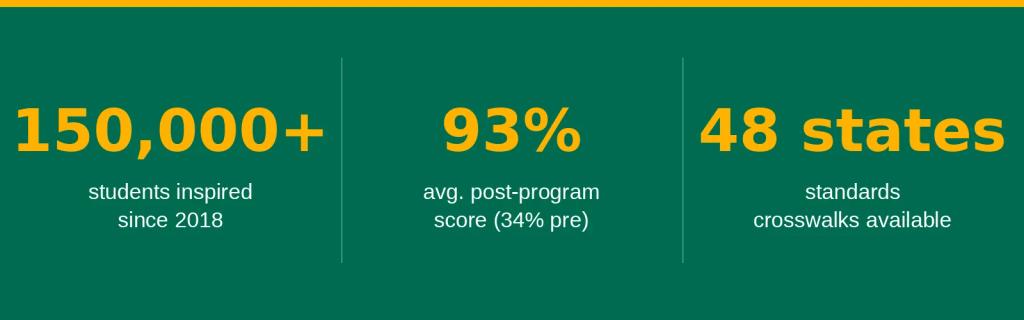
Rapunzl is also a mission-driven company, and the outcomes back it up. Students start at 34% on financial literacy assessments, well under the 64% national average, and finish averaging 93%, about 26–29 percentage points above the national average. Rapunzl has reached 150,000+ students since 2018 and distributed $300,000+ in scholarships. The company was named a 2022 Yass Prize finalist and won the 2022 STOP Award for Transformational Education, and its founders were named to Forbes 30 Under 30.
Unlike a sponsor-funded model, the incentive here is making sure every student graduates financially literate.
Best for: teachers who want students actively trading on live market data, need a Spanish-language option, and want outcomes they can point to when asked whether the program actually works.
2. NGPF (Next Gen Personal Finance): Best for a free lesson library
NGPF is a nonprofit with a huge, free library of lessons, activities, and assessments, run as a 501(c)(3), according to NGPF's own About Us page. If EVERFI feels too module-driven and you'd rather have raw material to build your own course, NGPF gives you the most to work with of anyone.
The catch is that NGPF is a library, not a live experience. You'll still want a simulator alongside it for hands-on investing, and plenty of teachers pair the two. There are also plenty of games and in-class activities linked through the platform that help with engagement even before a simulator enters the picture.
NGPF is the strongest free option here if you're willing to do the assembly work yourself; see Rapunzl vs. NGPF for a closer look at how the two fit together.
Best for: teachers who want maximum free flexibility and are happy to assemble their own course.
Bring Rapunzl into your classroom
Explore how Rapunzl helps students build real investing and personal finance confidence.
Set Up A Free Demo AccountEVERFI vs. NGPF: what's actually different?
EVERFI and NGPF are both free, but they solve different problems: EVERFI ships as a guided sequence of self-paced modules funded by corporate sponsors, while NGPF hands teachers a sprawling lesson-and-activity library to assemble into a course themselves. Neither puts students inside a live market the way Rapunzl's real-time investment simulator does.
A district weighing "free and guided" against "free and flexible" is really asking how much course-building time it wants a teacher to spend. For a closer, feature-by-feature look at how EVERFI and Rapunzl compare, see Rapunzl vs. EVERFI.
Quick Break: How do the five EVERFI alternatives compare at a glance?
Every EVERFI alternative here makes a different bet on what makes financial literacy stick: a free lesson library, a bank-funded module set, or a live investing experience. Of the five compared, Rapunzl is the only one built around a live-market simulator with real Nasdaq pricing rather than a static module library. Here's how the five stack up:
| Platform | Model | Live market data | Spanish | Best for |
|---|---|---|---|---|
| Rapunzl | Paid school or district license | Yes, real-time with live Nasdaq pricing | Yes | Active, live-market learning |
| NGPF | Free, nonprofit lesson library | No, simulated holdings only | Yes | A free lesson library |
| The Stock Market Game (SIFMA) | Free in most states (some regions charge a registration fee) | Delayed, about 15 to 20 minutes | Confirm with vendor | An established simulation |
| Ramsey Education | Paid, custom school or district quote | Confirm with vendor | Yes (4th edition only) | A scripted full course |
| Banzai | Free, bank and credit union sponsored | Yes, syncs to real stock prices (exact delay unconfirmed) | Yes | Bank-partner-driven programs |
3. The Stock Market Game (SIFMA Foundation): Best for an established simulation
The Stock Market Game is a long-running classroom investing program with deep ties to state economic-education councils. It swaps EVERFI's passive modules for an actual trading simulation, which is a real upgrade in engagement, and in many states your local Council of Economic Education covers the cost.
SMG runs in two pricing modes — a delayed, end-of-day mode and a real-time mode — and many local programs still default to the delayed mode, so weigh how much real-time data matters to your unit before you commit and confirm which mode your program uses.
Best for: teachers who want a credible, affiliate-supported simulation and don't need live pricing.
4. Ramsey Education: Best for a scripted full course
Ramsey's Foundations in Personal Finance is a fully-scripted, video-based semester curriculum with a strong budgeting-and-debt focus, according to Ramsey Education's own site. If EVERFI's modular structure leaves you wanting one coherent course with clear teacher scripts, Ramsey delivers exactly that. The program is straightforward, battle-tested with a decades-long track record.
It's lighter on hands-on investing, and its faith-based, debt-averse philosophy can complicate preparing students for college and FAFSA. Pair it with a simulator if market practice is a priority. The program also offers a great teacher community to learn from other instructors implementing the course.
Best for: teachers who want a turnkey course and are comfortable with a faith-based, debt-averse philosophy.
5. Banzai: Best for bank-partner-driven programs
Banzai, like EVERFI, is usually distributed free through financial-institution partners and focuses on real-life financial scenarios, according to Banzai's own About Us page. If you like EVERFI's sponsored model but want a different content style, Banzai is the closest analog on this list.
Because it shares the sponsor-funded approach, it also carries the same trade-off some teachers are trying to get away from, and it's lighter on live investing practice. Banzai offers a more technology-forward approach than EVERFI, but lacks curriculum content and rarely provides enough content to satisfy a full course.
Banzai likely offers the worst alternative to EVERFI in terms of depth and scope, but some teachers find success pairing these resources with NGPF.
Best for: teachers comfortable with the sponsored model who want an EVERFI-style alternative.
How to choose an EVERFI alternative for your classroom
EVERFI's biggest strengths, free and low-lift, are real, and enough for a compliance-first classroom. But if students are only clicking through modules, the fix is active learning. Rapunzl is built specifically around doing: real portfolios, real-time prices, and a curriculum that reinforces what students learn as they trade, the same approach that grew from one Chicago high school in 2018 to nationwide adoption.
Sources
- EVERFI — Financial Literacy for High School (2026)
- NGPF — About Us (2026)
- The Stock Market Game — SIFMA Foundation (2026)
- Ramsey Education (2026)
- Banzai — About Us (2026)
Frequently Asked
Questions
EVERFI is free to schools through corporate sponsorship. Some alternatives (NGPF, Intuit) are also free, and others use different models. Cost usually isn't the deciding factor. Engagement and hands-on practice are. Confirm current terms with each provider.
Rapunzl is built around active, live-data investing, with students managing real-time stock and crypto portfolios. The Stock Market Game also offers a trading simulation, though with delayed rather than live pricing. EVERFI and Banzai are more module-based.
Some educators prefer curriculum designed for classroom outcomes rather than shaped by financial-institution sponsors. It's a values choice, not a knock on quality, but it's a common reason teachers explore alternatives.
Rapunzl offers its curriculum in both English and Spanish. Spanish availability varies among the others, so check directly with each vendor.
Look for CEE-pillar alignment and a state-specific standards crosswalk. Rapunzl provides crosswalks through its Educator Dashboard so you can show administrators exactly what's covered.
EVERFI's investing content stays inside self-paced modules with fictional scenarios. A platform built around a live simulator, like Rapunzl's real-time investment simulator, has students manage an actual simulated portfolio priced with live Nasdaq data instead of clicking through a scripted example. That distinction is the main reason teachers look for an EVERFI alternative in the first place.
NGPF is a free library of lessons and activities, not a guided course, so most teachers use it to build their own sequence rather than assign it end to end. Many pair NGPF with a simulator for the hands-on investing practice it doesn't provide on its own.
Yes. Nothing here requires dropping EVERFI's other modules (digital wellness, career readiness, etc.); districts commonly keep EVERFI for broader compliance topics while swapping in a dedicated platform like Rapunzl, NGPF, or PersonalFinanceLab specifically for the personal finance and investing unit.
Want to replace passive modules with active investing? Start a free Rapunzl teacher demo account and see the live-data simulator and curriculum for yourself. No finance background required.
By Nate Thomas, School Partnerships Lead at Rapunzl and former classroom teacher.