



















NGPF Alternatives: 6 Financial Literacy Platforms for 2026
Next Gen Personal Finance (NGPF) earned its reputation. It's free and run as a 501(c)(3) nonprofit, and its library of lessons and activities is deep, according to NGPF's own About Us page. If you're already using it and it's working, keep using it. Nobody's going to talk you out of a good thing.
So why do so many teachers go looking for an alternative? Because "the biggest library" and "the right fit for my classroom" aren't always the same thing. Maybe you want students trading with live market data instead of filling in another worksheet. Maybe you want something that engages students and brings financial literacy to life with real-world learning.
The good news is that there are tons of financial literacy platforms worth comparing (and many of them can actually pair with NGPF resources). Below we dive into a few of them and give an honest evaluation of what works, what doesn't, and how each platform fits for different classrooms.
What to look for in an NGPF alternative
When our school partnerships team talks with teachers who are switching or adding a tool, the same five questions come up:
- Standards alignment. Does it map to the Council for Economic Education (CEE) pillars and your state's requirement? And can you actually prove that coverage to an administrator who asks?
- Hands-on practice. Does it teach investing through real, applied experience, or just enough to pass a test?
- Prep time. Could a teacher with no finance background run this program tomorrow morning without a summer of prep?
- Access and equity. Is it available in Spanish? Is it screen-reader accessible?
- Motivation. Is there anything that engages students and makes them want to come back?
What NGPF doesn't include (and where to look instead)
NGPF earns its reputation. Its free library covers more ground than almost any competitor's, and NGPF has also built out a deep Spanish-language translation effort across its courses, a real strength worth crediting up front.
What the library doesn't include: a persistent, real-time trading simulator (NGPF's Arcade tools, including its Investing Simulator, use fictional holdings rather than live market data), a dedicated state-standards crosswalk tool, a teacher dashboard beyond basic answer keys and assessments, or a national scholarship competition.
Rapunzl includes all four: a real-time investment simulator (a simulated $10,000 stock and crypto portfolio on live Nasdaq pricing), an Educator Dashboard with grade export and standards crosswalks, and a free national scholarship competition that runs January through late April. Neither approach is wrong; they solve different classroom needs.
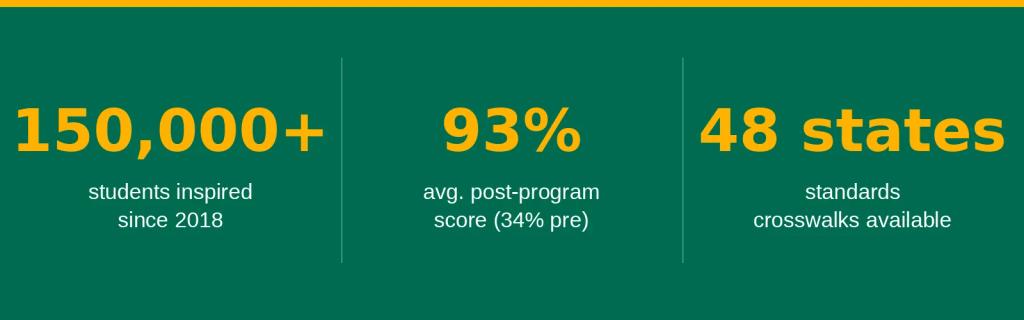
There's no single best NGPF alternative, either. It depends on which of those gaps matters most to your classroom: a live simulator or a scholarship competition. Teachers who want NGPF's depth plus hands-on practice tend to land on Rapunzl, whose standards-aligned course pairs a real-time investment simulator with a curriculum used by 150,000+ students since 2018. Teachers who mainly need a trading contest without a full curriculum often prefer The Stock Market Game instead.
1. Rapunzl: Best for live, hands-on investing
Rapunzl is a financial literacy platform built around our real-time investment simulator. Students manage a simulated $10,000 portfolio of stocks and crypto priced with live Nasdaq data. No delayed quotes. When the market moves during 4th period, their portfolios move too. Suddenly, students start checking the news because it affects their money. Learning becomes relevant.
Around that simulator sits a standards-aligned curriculum built on 40+ modules of project-based learning, scaling from a three-week unit all the way up to a 28-week, year-long course, in both English and Spanish. There's also an Educator Dashboard with grade export and standards crosswalks, and assessment grades integrate with most LMS providers such as Clever, ClassLink, and Google Classroom. It's screen-reader accessible and hosted on Google Cloud.
Rapunzl also runs a free national scholarship competition each year, from January through late April, drawing nearly 100,000 students who compete head-to-head with their simulated portfolios.
What really sets Rapunzl apart is the mission and the proof behind it. Students walk in scoring an average of 34% on financial literacy assessments, below the 64% national average, and walk out averaging 93%, roughly 26–29 percentage points above the national average.
Rapunzl grew from a single high school in Chicago in 2018 to nationwide adoption. Along the way it has inspired 150,000+ students and distributed $300,000+ in scholarships, and it was named a 2022 Yass Prize finalist and won the 2022 STOP Award for Transformational Education. Its founders were also named to Forbes 30 Under 30 for their work in education. A lesson library alone can't put that kind of track record on the table.
Best for: teachers who want students learning by doing on live market data, classrooms that need a Spanish option, and schools that want measurable outcomes and a shot at scholarship money.
2. EVERFI: Best for fully-sponsored digital modules
EVERFI offers self-guided digital courses that are free to schools because corporate and financial-institution sponsors underwrite them, according to EVERFI's own course page. The modules are polished, and "no cost to the district" makes EVERFI easy to roll out at scale.
The trade-off is engagement. The EVERFI experience is largely passive. Students read modules and fill in worksheets rather than actively managing anything. It covers the standards at a broad level, which suits a compliance-first rollout, but "checked the box" and "students learned it" are not the same learning outcome.
If minimal-setup coverage is your goal, it's a reasonable pick. If you want students actually investing, it's worthwhile to explore a combination of The Stock Market Game and NGPF, PersonalFinanceLab, or Rapunzl.
Best for: districts that want a free, low-lift, self-paced digital option.
Quick Break: NGPF vs. 6 alternatives at a glance
Of the six alternatives compared here, Rapunzl and PersonalFinanceLab are the only ones built around a live, real-time trading simulator; NGPF's own library uses fictional holdings instead.
Here's how the six stack up:
| Platform | Live simulator | Spanish | Standards crosswalk | Teacher dashboard/grading | Cost model |
|---|---|---|---|---|---|
| NGPF | No, fictional holdings only | Yes, 231+ translated resources | Confirm with vendor | Confirm with vendor | Free, nonprofit |
| Rapunzl | Real-time, live Nasdaq pricing | Yes | Yes, in Educator Dashboard | Yes, Educator Dashboard | Paid school or district license |
| EVERFI | Confirm with vendor | Yes, bilingual course toggle | Yes, Jump$tart + CEE aligned | Yes, auto-graded dashboard | Free, sponsor-funded |
| The Stock Market Game (SIFMA) | Delayed ~15-20 min, real-time mode also offered | Confirm with vendor | Yes, 1,000+ correlated lesson plans | Confirm with vendor | Little to no cost |
| Ramsey Education | Confirm with vendor | Yes, 4th edition only | Yes, state-specific pages | Yes, auto-graded, customizable | Paid, custom district quote |
| PersonalFinanceLab | Real-time in market hours | Confirm with vendor | Yes, state-specific pages | Yes, activity/diversification reports | Paid school or district license |
| Intuit for Education | No, budgeting walkthrough only | Confirm with vendor | Yes, CEE + Jump$tart aligned | Confirm with vendor | Free |
3. The Stock Market Game (SIFMA Foundation): Best for legacy brand recognition
Run by the SIFMA Foundation, The Stock Market Game is one of the oldest classroom investing programs out there, with decades of history and strong ties to state economic-education councils. A lot of teachers remember playing it themselves in school. Our own founders did.
Its main limitation is the trading experience and dated technology. SMG runs in two pricing modes — a delayed, end-of-day mode and a real-time mode — and many local programs still default to the delayed mode, so confirm which one your program uses; either way, the interface feels its age. Still, it's a solid, credible option, and in many states your local Council of Economic Education covers the cost, so it's worth reaching out, especially if you're trying to supplement NGPF materials.
Best for: teachers who want an established, affiliate-supported simulation and don't need live data.
4. Ramsey Education (Foundations in Personal Finance): Best for a scripted, values-based course
Ramsey's Foundations in Personal Finance is a structured, video-driven course with a strong point of view on money, according to Ramsey Education's own site. It leans hard on budgeting, saving, and avoiding debt, and teachers who want a fully-scripted semester in a box tend to like it.
Where it thins out is investing practice. The Ramsey philosophy is faith-based and strongly debt-averse, which some teachers find complicates preparing students for college and FAFSA, and it's cautious on individual stock investing.
Students get less hands-on market experience as a result. If a live simulator is central to your unit, you'll be pairing Ramsey with something else. That said, it's been in classrooms for decades, so it works for plenty of districts, particularly ones willing to pair it with a simulator for the investing unit.
Best for: teachers who want a turnkey course and are comfortable with a faith-based, debt-averse philosophy.
5. PersonalFinanceLab: Best for a budgeting + trading combo
PersonalFinanceLab pairs a stock-market simulation with a budgeting game and assessments, according to PersonalFinanceLab's own site. It's a capable, education-focused tool with a narrower footprint than the giants. If you want budgeting simulation and trading living in the same place, shortlist it.
Its scope is more specialized and its content library smaller than NGPF's, and it tends to cost more than the free options, which can be prohibitive for public and charter schools. Think of it as a focused simulator-plus-budgeting tool rather than a complete curriculum.
The program is useful for after-school programs where students are independently researching information outside of the platform, but integrated learning options are limited and it does not have a mobile option, so most teachers use it to supplement a full course rather than replace one.
Best for: teachers who want budgeting and trading simulation bundled together.
6. Intuit for Education: Best for tapping a familiar brand
Intuit for Education offers free personal finance and entrepreneurship curriculum backed by a name students and parents already recognize, according to Intuit for Education's own site. The content is clean and modern, and the brand carries real weight in a classroom.
Be honest with yourself about depth, though. Like other module-based options, it leans toward guided lessons rather than a live simulator, and the curriculum itself is fairly rudimentary. Most teachers who want a free option will get more mileage pairing NGPF's depth with a simulator. Intuit's occasional student scholarships are a nice bonus, but they aren't exclusive to teachers who use the curriculum.
Best for: teachers who want free, modern, brand-name curriculum and like the Intuit experience.
How to choose an NGPF alternative
Strip it all down and the decision usually comes to one question: do you want a content library or a live experience? NGPF, EVERFI, and Intuit lead with content, and they're free, which matters for a zero-budget classroom.
Rapunzl leads with hands-on investing on live market data, wrapped in a standards-aligned course and a free national scholarship competition that runs January through late April.
For a lot of classrooms, the best answer is a blend: keep NGPF for certain lessons, and add a live simulator for the part it can't do. If a paid simulator isn't in the budget at all, free tools like Investopedia or MarketWatch offer limited flexibility but reasonably accurate pricing, a fine stopgap until you can add something more integrated.
But if the piece you've been missing is real, engaging, live investing practice, that's exactly the gap Rapunzl was built to fill. For a direct side-by-side, see our Rapunzl vs. NGPF comparison. If you're comparing programs more broadly, start with our guide to the best personal finance curriculum for high school.

Free vs. paid: what a free tool doesn't include
Free and paid aren't a value judgment here, they're a trade-off. NGPF, EVERFI, and Intuit for Education cost nothing to license, and that's a real advantage for a teacher who already knows how to build a semester from scratch. What a free tool asks in return is prep time: assembling a sequence, sourcing practice activities, and building engagement without a built-in incentive structure.
Paid, integrated platforms make the opposite trade. Rapunzl's students post an average 93% score on post-program financial literacy assessments, up from 34% before the course, a jump the simulator and scholarship competition are built to drive on their own rather than leaving it to the teacher to engineer.
Sources
- EVERFI — Financial Literacy for High School (2026)
- The Stock Market Game — SIFMA Foundation (2026)
- Ramsey Education (2026)
- PersonalFinanceLab (2026)
- Intuit for Education (2026)
- NGPF — About Us (2026)
Frequently Asked
Questions
Yes, NGPF is free, and cost is rarely the reason teachers switch. They add or swap tools because they want live-data investing practice, a Spanish option, stronger student motivation, or less prep. A big lesson library doesn't automatically deliver those.
Rapunzl, The Stock Market Game, and PersonalFinanceLab all include simulations. Rapunzl uses live Nasdaq pricing for both stocks and crypto, so student portfolios reflect real market movement during class.
Rapunzl offers its standards-aligned curriculum in both English and Spanish. Availability varies across the other platforms, so confirm current language options directly with each vendor.
Look for alignment to the CEE's six pillars and a standards crosswalk you can hand to an administrator. Rapunzl provides state-specific crosswalks through its Educator Dashboard.
Yes. Most platforms let you preview first. You can start a free Rapunzl teacher demo account and explore the simulator and curriculum before you bring it to students.
NGPF and EVERFI are both free, but they solve different problems. NGPF is a deep, teacher-curated lesson library you assemble yourself; EVERFI is polished, self-guided digital modules a district can roll out with zero prep. If you want a library to build lessons from, pick NGPF. If you want a passive, no-setup option for compliance coverage, EVERFI fits better. Neither includes a live trading simulator.
No. NGPF's library includes simulations and games within its Arcade section, but it does not center on a persistent, real-time trading simulator the way Rapunzl, The Stock Market Game, or PersonalFinanceLab do. Students working through NGPF materials read lessons and complete activities rather than managing a live portfolio over a semester.
Yes, and many teachers do exactly this. Keep NGPF's lesson library for topics it covers well, then add Rapunzl's live $10,000 simulator for the hands-on investing practice a static library can't provide. It's a common combination, not a replacement decision.
Ready to see live-data investing in action? Start a free Rapunzl teacher demo account and explore the simulator, curriculum, and Educator Dashboard for yourself. No finance background required.
By Nate Thomas, School Partnerships Lead at Rapunzl and former classroom teacher.