




















The Best Personal Finance Curriculum for High School (2026)
With a majority of states requiring personal finance for graduation, more and more teachers and administrators are searching for engaging financial literacy programs that meet standards and help develop lifelong skills for students. And a lot of times, the options are confusing. Some courses offer a lecture-and-quiz format, others are hands-on. Some programs like NGPF offer a free library of resources, but they offer less guidance on how those resources pair into a full course. Other programs like Ramsey Solutions are values-driven, and some rely upon game-based learning and real-world simulations.
This guide compares the best personal finance curriculum options for high school in 2026, using a consistent rubric so you can match a program to your classroom. We explore each of the top financial literacy options available to teachers and highlight which works best in different classrooms.
How to evaluate a personal finance curriculum
A strong high school curriculum should clear five bars:
- Standards alignment. The curriculum should map to the Council for Economic Education's six pillars — Earning Income, Saving, Spending, Investing, Managing Credit, and Managing Risk — in addition to your state's requirement. This ensures that students are covering all of the personal finance basics and are financially equipped for graduation.
- Engagement. Personal finance dies on the vine if it's dry. The best curricula make students do something, not just read. Curriculum should have engaging simulations, projects, or other ways for students to apply their learning.
- Teachability. Most teachers assigned personal finance don't have a finance background. The curriculum should carry the expertise for them and provide teaching guides or tools to facilitate implementation.
- Depth and coverage. The curriculum should cover the whole arc from budgeting and investing to credit and risk. Leaving holes in a financial literacy program in high school sets students up with knowledge gaps for life.
- Access and equity. Multi-language availability, accessibility, and device flexibility to ensure that a program can reach every student in your classroom.
1. Rapunzl: Best for hands-on, standards-aligned learning
Rapunzl provides a standards-aligned personal finance curriculum built around our real-time investment simulator. Students simulate $10,000 stock portfolios, enter their portfolios into scholarship competitions, and access integrated curriculum through the platform. That combination is the point: students learn the concepts and practice. The program incorporates project-based learning throughout the curriculum and brings real-world relevancy to the curriculum.
With more than 40 modules of curriculum, Rapunzl was designed to scale from a three-week unit to a full 28-week, year-long course and is available in English and Spanish. Rapunzl was also designed for teachers without a finance background. Lessons are scaffolded and the simulator carries the hands-on instruction. The Educator Dashboard offers grade export and state-specific standards crosswalks. The platform is screen-reader accessible, hosted on Google Cloud, and assessment grades integrate with a majority of LMS providers such as Clever, ClassLink, and Google Classroom.
And if that weren't enough, Rapunzl also hosts a free national scholarship competition from January through late April each year, which attracts nearly 100,000 students to compete head-to-head with their simulated portfolios.
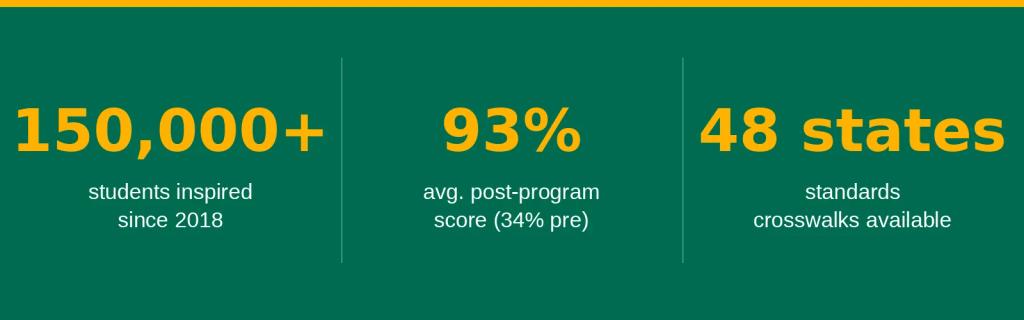
Most importantly, the Rapunzl curriculum is proven to work. Across Rapunzl's programs, students move from an average of 34% on financial literacy assessments — below the 64% national average — to 93%, about 26–29 percentage points above the national average. Rapunzl has reached 150,000+ students since 2018 and distributed $300,000+ in scholarships. The program was named a 2022 Yass Prize finalist and won the 2022 STOP Award for Transformational Education, and the company's founders were named to Forbes Under 30 for the technology.
Best for: Teachers who want engagement and standards coverage in one program, an engaging way to teach the investing portion of personal finance, and those who value a Spanish option and measurable outcomes.
2. NGPF (Next Gen Personal Finance): Best free library
NGPF offers a huge, free library of lessons and activities, run as a 501(c)(3) nonprofit, according to NGPF's own About Us page. For flexibility and breadth at zero cost, nothing else matches it. The program offers some immersive projects and links to free simulations and tools to build or supplement a course, but in many ways you can think of NGPF as the IKEA of personal finance.
They have absolutely everything you could think of, but you better be handy and know how to put it all together into a course. In some instances, that can be great.
If an educator feels comfortable teaching personal finance and is seeking materials on niche topics, no other site can compare. The program offers full customability, but requires significant teacher investment to make a course work for your classroom. With that said, we do see a lot of teachers that leverage NGPF resources and then integrate the Rapunzl simulator.
This provides a cost-effective way to elevate engagement, promote real-world learning with an investment simulator, and meet state graduation requirements. We break down how NGPF and Rapunzl differ in Rapunzl vs. NGPF.
Best for: teachers who want free, flexible content and enjoy building their own course.
Quick Break: How do the top personal finance curricula compare at a glance?
Five programs solve the same problem in very different ways. NGPF and EVERFI hand teachers a free library and step out of the way, Ramsey scripts the whole semester for you, and Intuit for Education keeps things brand-recognizable and free. Rapunzl is the only program in this comparison built around a real-time investment simulator, paired with a scaffolded English-and-Spanish curriculum that scales from a three-week unit to a full 28-week course, and an Educator Dashboard with built-in grade export and state standards crosswalks.
Here's how the five stack up:
| Curriculum | Curriculum length | Spanish | Simulator | Standards alignment | Teacher dashboard | Cost model |
|---|---|---|---|---|---|---|
| Rapunzl | 3-week unit up to a 28-week, year-long course | Yes (English + Spanish) | Yes, real-time: simulated $10,000 stock and crypto portfolio on live Nasdaq pricing | Yes, CEE-aligned with state-specific standards crosswalks | Yes, Educator Dashboard with grade export and crosswalks | Paid school or district license |
| NGPF | Semester, trimester, or full-year course (9-68 lessons) | Yes, 231+ translated resources | No; simulator uses fictional holdings, no real market data | National-standards aligned; a dedicated state-crosswalk tool: confirm with vendor | Confirm with vendor | Free (501(c)(3) nonprofit) |
| Ramsey Education | 13 chapters, roughly one semester (0.5 credit) | Yes, 4th edition only | Confirm with vendor | Yes, state graduation-requirement pages | Yes, auto-graded assessments and customizable syllabi | Paid, school/district custom quote |
| EVERFI | 9 modules, 40-50 minutes each | Yes, per-course language toggle | Confirm with vendor | Yes, aligned to Jump$tart and CEE standards | Yes, automatic grading with built-in reporting | Free, sponsor-funded |
| Intuit for Education | 150+ hours, fully modular and customizable | Confirm with vendor | No; the Mint Simulation is a budgeting walkthrough, not a market simulator | Yes, aligned to CEE and Jump$tart, maps to individual state standards | Confirm with vendor | Free |
3. Ramsey Education (Foundations in Personal Finance): Best scripted course
Ramsey's Foundations in Personal Finance is a polished, video-driven, fully-scripted course with a strong budgeting-and-debt philosophy, according to Ramsey Education's own program page. For a teacher who wants a turnkey semester in a box, it's hard to beat on convenience.
Its investing coverage is lighter and more cautious by design, so if hands-on market practice matters to you, plan to add a simulator. Additionally, Ramsey's aversion to debt has caused some issues with teachers who are trying to prepare their students for college and FAFSA. The program has existed for decades though, so it's working for some districts, but there's a lot that could be improved or supplemented with NGPF and EVERFI.
Best for: teachers who want a turnkey, opinionated course and are comfortable with a faith-based, debt-averse philosophy.
Bring Rapunzl into your classroom
Explore how Rapunzl helps students build real investing and personal finance confidence.
Set Up A Free Demo Account4. EVERFI: Best free sponsored modules
EVERFI provides free, self-paced digital modules underwritten by corporate sponsors, according to EVERFI's own course page. It's low-lift to adopt and covers the standards at a broad level, which suits a compliance-first rollout. Unfortunately, when your primary goal is to appease compliance, student learning typically suffers.
The EVERFI learning experience is more passive than hands-on; students are typically tasked with reading handouts and filling in worksheets. The program can be implemented effectively when supplemented with real-world learning tools and a teacher familiar with the subject matter, but this is the most compliance-forward option on the list.
Best for: districts wanting a free, low-effort digital option at scale that can satisfy requirements instantly
5. Intuit for Education: Best brand-name free curriculum
Intuit for Education offers modern, free personal finance and entrepreneurship curriculum from a well-known consumer-finance brand, according to Intuit for Education's own site. The content is clean and current, and the name resonates with students. Like other module-based options, it leans toward guided lessons rather than a live simulator, and the curriculum is very rudimentary.
Although the curriculum is free, most teachers would be better suited using EVERFI or NGPF as free options because they offer more teacher learning tools and more engaging curriculum options. Although Intuit for Education does offer occasional scholarships for high school students, these opportunities are not exclusive to students who use their curriculum.
Best for: teachers who want free, modern, brand-name curriculum and enjoy the Intuit user experience
Which curricula pair well together?
None of these five programs has to be an exclusive choice, and plenty of teachers run two at once. NGPF's free lesson library covers the "why" of personal finance in more depth than almost anything else on this list, but it stops short of hands-on investing practice. Pairing it with Rapunzl's real-time simulator fills exactly that gap: NGPF supplies the curriculum backbone, and Rapunzl's simulated $10,000 portfolio supplies the practice NGPF's library doesn't include on its own.
The same implementation can be accomplished with EVERFI, which lacks engaging real-world tools to teach economics or investing, but can provide a core curriculum at no cost to a budget-conscious district while leveraging Rapunzl as a supplementary tool.
Teachers already running Ramsey's scripted semester sometimes add a dedicated simulator alongside it for the same reason, since Ramsey's course is built around video lessons and a workbook rather than live-market practice. There's no wrong combination here as long as the pairing covers what either program leaves out on its own.
If there's no budget line for this at all, start with what's already free. NGPF is a 501(c)(3) nonprofit and its entire lesson library costs nothing. EVERFI's modules are funded by corporate sponsors, so schools pay nothing to use them. Intuit for Education is free as well.
None of the three includes a live trading simulator, so the tradeoff is time: a teacher assembling a coherent semester from a free library is doing real curriculum-design work that a paid, integrated course already did for them. Teachers with no budget can start with NGPF's free library, EVERFI's free sponsored modules, or Intuit for Education's free course, then add a real-time simulator like Rapunzl's for the hands-on investing practice those free libraries don't include on their own.
Does this curriculum meet my state's personal finance requirement?
More states are adding a stand-alone personal finance course to their graduation requirements every year, and for a district evaluator, "standards alignment" is really a compliance question wearing a curriculum label. The real question isn't whether a program covers personal finance in general; it's whether it maps to the specific standard your state just adopted, and whether a principal can document that mapping without building a spreadsheet from scratch.
Rapunzl provides state-specific standards crosswalks through its Educator Dashboard, so a district can document exactly which of its state's personal finance graduation requirements each module satisfies.
Check your state's standards and compare what each program shows for your requirement before you commit a semester to it, and receive a summary of your state-specific standards.
How to decide the personal finance curriculum for your class
At the end of the day, even when you're deciding about how to teach money, it comes down to dollars and cents. The easiest distinction between some of the largest financial literacy providers is costs. Some groups such NGPF, EVERFI, and Intuit offer free content libraries that can make an experienced teacher's life a breeze. On the flipside, these free resources have limited tools to elevate student engagement and can often leaving the learning feeling flat.
Conversely, integrated, hands-on courses such as Rapunzl or Ramsey can provide a fully-customized, curated personal finance course that aligns to state-standards and engages students deeper, but there's a cost.
If your students need to feel investing to understand it, and you want standards coverage and outcome data in the same package, Rapunzl is the strongest all-around fit for 2026. If budget is the hard constraint, start with NGPF's free library and add a simulator for the hands-on piece if the budget allows.
If you cannot afford to incorporate a paid simulator, explore some of the free options such as Investopedia or MarketWatch which offer limited flexibility but provide sufficiently accurate pricing.
Sources
- Council for Economic Education — National Standards for Personal Financial Education (2021)
- NGPF — About Us (2026)
- EVERFI — Financial Literacy for High School (2026)
- Ramsey Education — Foundations in Personal Finance (2026)
- Intuit for Education (2026)
Frequently Asked
Questions
For classrooms that want engagement plus standards coverage in one place, we'd point to Rapunzl, because it pairs a standards-aligned course with a live-data investment simulator and documented outcomes. The best fit still depends on your budget, students, and goals.
Yes — NGPF, EVERFI, and Intuit for Education all offer free options. Free content libraries give you flexibility; you'll typically add a simulator for hands-on investing practice.
Rapunzl and Ramsey are both built to be teachable without prior finance expertise. Rapunzl scaffolds lessons and lets the simulator carry the investing instruction; Ramsey provides full scripts.
The strongest ones align to the CEE's six pillars and support state mandates. Rapunzl provides state-specific standards crosswalks through its Educator Dashboard so you can document coverage.
Rapunzl offers its standards-aligned curriculum in both English and Spanish. Spanish availability varies among the others — confirm with each provider.
Free libraries (NGPF, EVERFI, Intuit for Education) give experienced teachers flexible, no-cost lesson content but leave engagement and hands-on practice to the teacher to build. Paid, integrated courses (Rapunzl, Ramsey) bundle a full scope-and-sequence, teacher scaffolding, and, in Rapunzl's case, a live investment simulator into one product.
Rapunzl is the only curriculum on this list built around one: students manage a simulated $10,000 portfolio of stocks and crypto on live Nasdaq data as part of the course itself. NGPF and EVERFI point teachers to outside simulation tools rather than building one in.
It varies widely by program. Rapunzl's curriculum scales from a three-week unit up to a full 28-week, year-long course, so a school can fit it into a mini-mester or a full semester.
Rapunzl's Educator Dashboard offers grade export and state-specific standards crosswalks, so a teacher can document coverage without building a separate tracking system.
Yes. Rapunzl's national scholarship competition is free for students and runs January through late April, adding real stakes on top of the curriculum.
See a hands-on, standards-aligned curriculum in action. Start a free Rapunzl teacher demo account and explore the course, simulator, and Educator Dashboard — no finance background required.
By Clarissa Collins, Curriculum Designer at Rapunzl, building standards-aligned financial literacy curriculum for grades 6–12.