














rapunzl logo green investing castle
Request Free DemoFree Demo
rapunzl mobile hamburger icon
Rapunzl
Educators
Districts
After-School
Parents
Courses
Investment Simulator
Teacher Portal
Integrated Curriculum
Real-Time Market Data
Certifications
Partners
About Us
Blog
Contact
Simulator Login
Educator Login
Get Free Demo
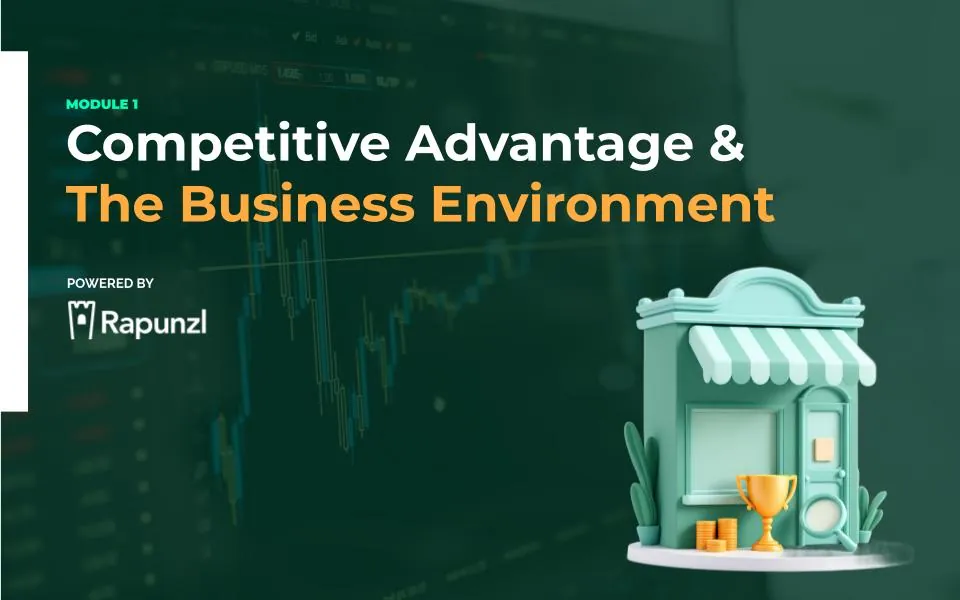
Competitive Advantage & The Business Environment cover graphic for the Rapunzl AP Business with Personal Finance curriculum
Module 41

Competitive Advantage & The Business Environment

This AP Business module teaches students to identify a company's competitive moat — cost advantage, differentiation, brand, or network effects — and scan the six PESTEL forces around it.
Students scan a real company of their choice, analyze its advantage and moat, run a six-force PESTEL scan marking each force an opportunity or threat, and defend a verdict on whether it is built to keep winning.

Module At A Glance

Grade Levels:
9th - 12th
Est. Length:
1-2 Weeks (19 slides)
Activities:
5 Activities
Articles:
1 Articles
Languages:
English
Curriculum Fit:
AP Business with Personal Finance — Units 1–5
Standards Alignment:
Aligned to the College Board AP Business with Personal Finance CED and the CEE National Standards for Personal Financial Education
magnifying glass with stock chart

Guiding Questions

  • What gives one business a lasting edge over its competitors?
  • How do cost advantage and differentiation differ?
  • What is a moat, and why can a superior product still fail?
  • What are the six PESTEL forces, and how do they shape a company?
  • How can this framework guide the decisions you make with money?

Enduring Understandings

  • A single success is easily copied; a moat is what makes an advantage endure.
  • A strong product is not enough when external forces move against it.
  • The same force can benefit one company and threaten another.
  • Sound investors evaluate both the moat and the surrounding environment.

Module Vocab & Key Topics

Competitive advantage
Whatever lets one business win customers again and again while its rivals struggle — a reason people keep choosing it over the shop next door.
Cost advantage
Winning by being cheaper to produce, so you can charge less and still profit (like a warehouse store that buys huge and sells cheap).
Differentiation
Winning by being distinct or preferred, so people choose you — and will sometimes pay more (like a premium sneaker or phone brand).
Moat
A lasting protection around a business that makes its advantage hard for rivals to copy — named after the water-filled ditch that guards a castle.
Brand
A name people trust so much they don't shop around, making it a kind of moat all on its own.
Switching costs
The hassle of leaving. Once your photos, texts, and apps live in one company's system, moving to a rival feels like moving houses — so you stay.
Scale
Being so big you can make each item cheaper than any newcomer, which loops back into a cost advantage.
Patents
A legal right that makes a company the only one allowed to sell something for a set number of years, common for new medicines and technology.
Network effect
When a product becomes MORE valuable to each user as MORE people use it — so the crowd itself becomes the moat and a better rival can still lose.
PESTEL
A six-letter checklist of outside forces every business has to deal with: Political, Economic, Social, Technological, Environmental, and Legal.

Try It

Moats & Weather

Read a company's moat, then the six forces around it, the way an analyst does.

Scenarios drawn from the module · September 2026

Moat Types

Which Moat?

Which mechanism explains why a better rival still can't beat each company below?

You look at five companies: a century-old cola brand, a phone-and-app ecosystem, a warehouse club that buys in bulk, a messaging app with billions of users, and a budget airline running on thin margins. Each one survives rivals for a different reason.

4 mechanismsmoat types across the five companiesno company shows all four

Each company's edge traces to a different mechanism — brand, switching costs, scale, or network effects — and no single company owns all four.
BrandSwitchingScaleNetwork
Old-school cola brand
Phone-app ecosystem
Warehouse club
Messaging app
Budget airline

A moat isn't one thing — brand, switching costs, scale, and network effects each protect a business a different way, and most companies lean on only one or two.

PESTEL Scan

PESTEL Weather Report

For an electric-car maker, is each force mostly an opportunity or a threat right now?

An electric-car maker reads its environment before its next model. Government incentives, rising battery-material costs, driver attitudes toward sustainability, fast-moving technology, and tightening emissions rules could each help the company or hurt it — sometimes both at once.

3 of 5forces read mostly as opportunities2 cut both ways

Government incentives and rising demand for sustainability favor the electric-car maker, while material costs and new rivals apply real pressure — several forces cut both ways.
OpportunityThreat
Political
Economic
Social
Technological
Environmental & Legal

The same force can help one company and threaten another, so a real PESTEL scan checks all six forces instead of stopping at the first good sign.

Network Effect

Better Product, Still Loses

A messaging app has a clunkier design than a slick new rival. Why does it still win?

A sleek new messaging app launches with a cleaner design and faster speed than the app on your phone. Almost nobody switches. Your friends are all still on the old app, your group chats live there, and leaving would mean losing every conversation history you have.

  • The old app has better marketing.Marketing wins attention once, but it doesn't explain why millions of people stay loyal for years — that takes a real moat.
  • Everyone's already there, so leaving costs you your friends and your history.That's the network effect: the app is valuable because of who else uses it, and switching means losing all of it — a moat a better product alone can't crack.
  • The new app is too expensive to advertise.Ad budget affects how many people hear about the app, not why an installed base of friends refuses to move.
  1. Rival Launchessleeker, faster
  2. Friends Stayon the old app
  3. Switch Costlose the history
  4. Old App Winsnobody moves

A better product can still lose when a network effect makes the crowd itself the moat, because leaving means losing everyone already there.

Verdict Call

Built To Keep Winning?

You scanned a company's moat and its PESTEL forces. Is it built to keep winning?

You scanned a streaming service: a strong brand and high switching costs (nobody wants to rebuild years of playlists) form its moat. But its PESTEL scan shows a cooling economy squeezing subscriptions and new rivals cutting prices to win customers.

  • Yes — the moat protects it forever.No moat is permanent; ignoring the tough outside forces is how even strong companies get caught off guard.
  • No — one tough force means it's finished.A single threat rarely sinks a company with a real moat behind it; a verdict weighs both sides together.
  • Yes, but keep watching — the moat is real and it still has to answer the tough forces.A sound verdict weighs the moat's strength against the forces working against it, and keeps checking as conditions change.
  1. Spot the Moatwhat protects it
  2. Scan PESTELsix forces
  3. Weigh Forceshelp or hurt?
  4. Make the Calldefend it

A moat only proves a company is protected today; a verdict on tomorrow has to weigh that moat against the forces still working against it.

Scenarios are illustrative and adapted from the Module 41 Teacher Guide, article, and activity; company examples are generic unless named in the module.