rapunzl logo green investing castle
Request Free DemoFree Demo
rapunzl mobile hamburger icon
Rapunzl
Educators
Districts
After-School
Parents
Courses
Investment Simulator
Teacher Portal
Integrated Curriculum
Real-Time Market Data
Certifications
Partners
About Us
Blog
Contact
Simulator Login
Educator Login
Get Free Demo
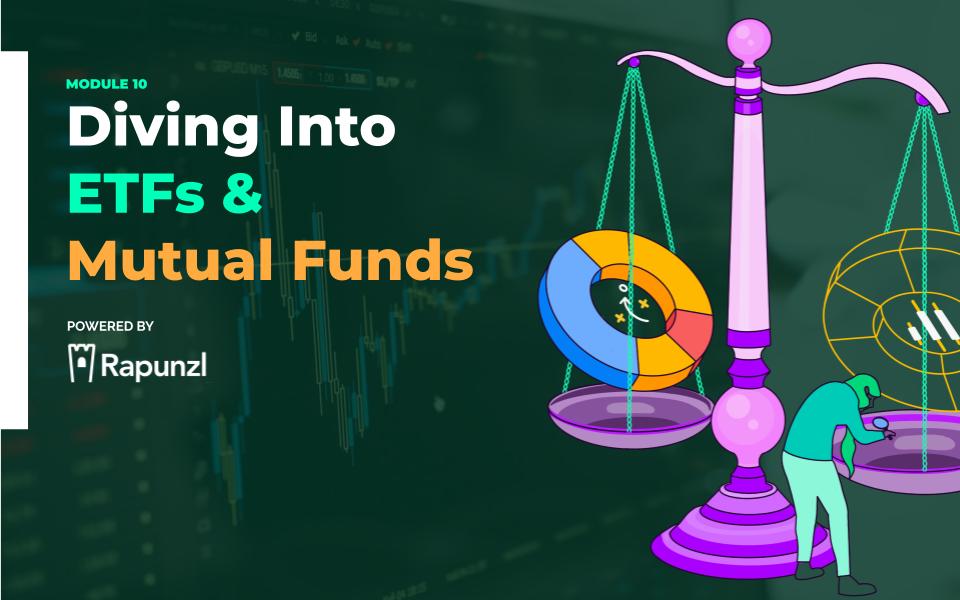
ETFs & Mutual Funds cover graphic for the Rapunzl personal finance curriculum
Module 10

ETFs & Mutual Funds

This module explores the importance of ETFs and Mutual Funds in achieving a diversified investment portfolio.
We discuss examples of different ETFs, explore the advantageous of low-expense ratio mutual funds, and examine why investors may prefer a passive investment strategy.

Module At A Glance

Grade Levels:
6th - 12th
Est. Length:
1-3 Hours (18 slides)
Activities:
3 Activities
Articles:
5 Articles
Languages:
English & Spanish
Curriculum Fit:
Math, Business, Economics, CTE, Social Studies
Standards Alignment:
CEE National Standards, Jump$tart National Standards & Relevant State Standards
magnifying glass with stock chart

Guiding Questions

  • What are ETFs and Mutual Funds?
  • How can ETFs and Mutual Funds help build a more diversified portfolio with exposure to hundreds of companies?
  • Are there any special tax treatments for ETFs or Mutual Fund which we should appreciate before investing?
  • What are Capital Markets and Why are they important?
  • How do investment banks help launch an ETF or Mutual Fund?

Enduring Understandings

  • ETFs & Mutual Funds provide a way for investors to invest in a basket of stocks or other assets at a much lower cost than purchasing all of the assets independently.
  • ETFs provide investors with the opportunity to own shares in an asset whose performance is designed to mirror a stock index or industry.
  • Mutual funds are more actively managed than ETFs, so they typically have higher fees.
  • Mutual funds also typically make distributions to investors which may provide an additional source of income for some investors.

Module Vocab & Key Topics

Exchange Trade Funds (ETFs)
These are professional funds that can be bought and sold on a stock exchange, similar to stocks. ETFs track an index, such as the S&P 500 or the Nasdaq 100, and their performance is based on the performance of those indexes. ETFs are ideal for investors who want diversification within their portfolio at a low cost.
Mutual Funds
These types of funds pool money from many investors and invest it in a variety of different securities, such as stocks, bonds, options and commodities. Mutual funds spread out risk across numerous investments, providing investors with greater diversification than they could achieve by investing in only one security.
Risk/Return Ratio
The risk-return ratio is used to measure an investment’s potential return relative to its associated risk level. Generally speaking, higher risk investments have the potential for higher returns but also carry more inherent risks than lower risk investments do; therefore it is important for investors to consider both elements when evaluating any given investment opportunity prior to making any decisions about which ones may be appropriate for them.
Expense Ratio
This is an annual fee associated with managing a mutual fund or ETF; it covers administrative costs as well as other expenses related to managing the fund itself (such as research costs). Before investing in any fund it is important for investors to evaluate its expense ratio since this will affect how much total return they can expect from their investment over time.
Index Funds
These funds attempt to track a specific stock market index by purchasing all or most of the stocks represented in that index. For example, a fund that tracks the S&P 500 will purchase all or most of the 500 stocks represented in that index in order to match its performance as closely as possible.
Active Management
An approach where investment professionals make active decisions about the types and amounts of investments in order to outperform the market or beat certain benchmarks.
Passive Management
Passive management is an investment strategy whereby asset managers do not actively pick individual securities but rather invest according to predetermined criteria such as benchmarks like indices or sectors rather than picking individual securities. In addition passive managers generally seek low costs through minimal trading activity leading to efficient portfolio construction avoiding excess trading costs as well as taxes.
Leverage
Leverage is a way for investors to increase their return on investment by borrowing money from a lender or broker. This borrowed money is used to purchase securities with the hope that if the value of those securities increase, they can repay the loan with profits earned.


Worked Examples

Funds In Action

Four reasons a fund's tiny yearly fee is a big deal — and a big convenience.

Figures current · August 2026

Fee drag

1% Sounds Small

net return = gross return − expense ratio7% gross

Put $10,000 in two funds that both earn 7% a year for 30 years. One is an index fund charging a 0.03% expense ratio; the other charges 1.0%. Subtracting each fee leaves a net return of 6.97% versus 6.00% — a gap that looks trivial for exactly one year.

$18,050lost to the 1% fee by year 30$57,435, not $75,485

yr 0yr 15yr 30$10k$40k$75k1% fee$75,485$75,485$57,435$57,435

A one-percent fee, compounded for decades, quietly eats a large slice of the ending balance.

Diversification

One Purchase, Many Stocks

holdings = N in one shareone ETF

A single share of the Vanguard S&P 500 ETF held 518 different stocks in mid-2026 — every company in the S&P 500, from the largest down. Buying that one share hands you a sliver of all of them at once, instead of purchasing 518 stocks one by one.

518stocks in a single shareVanguard S&P 500 ETF

518 holdings · one share of VOO

A single fund share buys a slice of hundreds of companies at once.

Index vs active

Most Active Funds Trail

P(beat the index) < 50%15-year odds

Active funds try to beat the market by picking stocks. S&P's SPIVA scorecard checked every active large-cap U.S. fund over the 15 years ending 2024: 89.5% trailed the plain S&P 500 index. Only about 1 in 10 came out ahead.

89.5%of active funds trailed the index15 yrs · 1 in 10 beat it

≈90 of 100 active funds trailed · 15 yrs

Over long windows most active funds fail to beat a cheap index.

Cost, compounded

What the Fee Actually Costs

fees = Σ (expense ratio × balanceₜ)charged yearly

Each year the 1% fund skims 1% of whatever your balance is that year. Summed across 30 years on the $10,000 scenario, that comes to $7,906 in fees — versus just $282 in the 0.03% index fund. Because the balance keeps growing, so does the yearly cut.

$7,906total fees, the 1% fundvs $282 in the index fund

0.03% index  $75,485 kept  $282 fees1.0% active  $57,435 kept  $7,906 fees

Because the fee is charged on the whole balance every year, it grows as the balance does — small at first, largest at the end.

Sources: Vanguard S&P 500 ETF (VOO) held 518 stocks as of July 31, 2026 (S&P Dow Jones Indices / Vanguard holdings via stockanalysis.com). Active-fund underperformance: S&P Dow Jones Indices SPIVA U.S. Scorecard, Year-End 2024 — 89.5% of active large-cap funds trailed the S&P 500 over the 15 years ending December 2024. Both checked August 24, 2026. Fee-drag figures derived from a $10,000 lump sum at a 7% gross annual return over 30 years; recompute before editing.