rapunzl logo green investing castle
Request Free DemoFree Demo
rapunzl mobile hamburger icon
Rapunzl
Educators
Districts
After-School
Parents
Courses
Investment Simulator
Teacher Portal
Integrated Curriculum
Real-Time Market Data
Certifications
Partners
About Us
Blog
Contact
Simulator Login
Educator Login
Get Free Demo
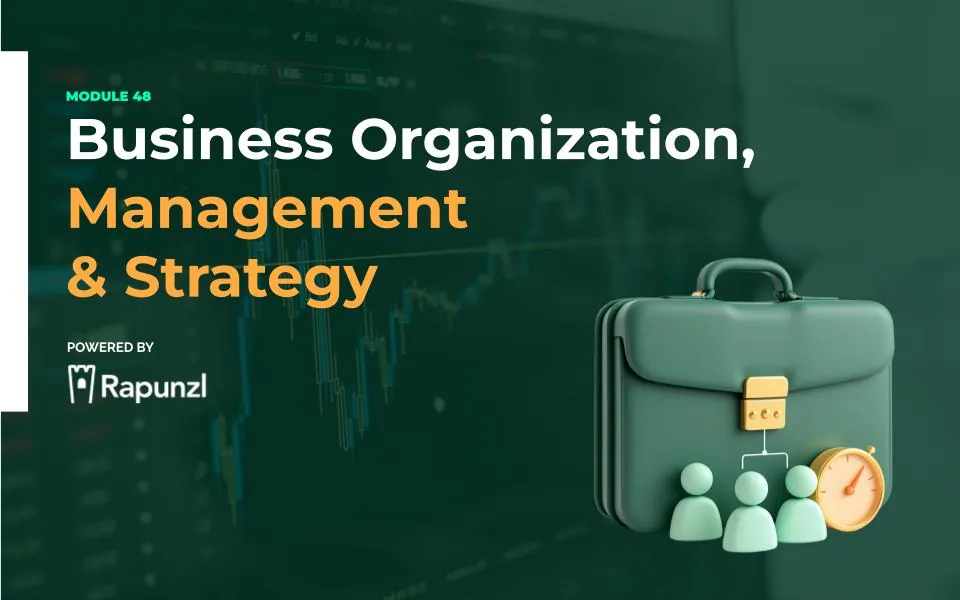
Business Organization, Management & Strategy cover graphic for the Rapunzl AP Business with Personal Finance curriculum
Module 48

Business Organization, Management & Strategy

This AP Business module opens on a restaurant with a full house that can still collapse without management, then teaches the four functions of management and four leadership styles.
Students learn what makes a number a KPI instead of a vanity metric, why ethics reaches down a global supply chain, and build the KPI dashboard a business owner should watch.

Module At A Glance

Grade Levels:
9th - 12th
Est. Length:
1-2 Weeks (20 slides)
Activities:
5 Activities
Articles:
3 Articles
Languages:
English
Curriculum Fit:
AP Business with Personal Finance — Units 1–5
Standards Alignment:
Aligned to the College Board AP Business with Personal Finance CED and the CEE National Standards for Personal Financial Education
magnifying glass with stock chart

Guiding Questions

  • What does a manager actually do, and how is managing different from leading?
  • Why does the same leader succeed in one situation and struggle in another?
  • How can a business tell whether it is winning without waiting to succeed or fail?
  • When is a legal choice still the wrong one — and who is affected by it?
  • Why is a company responsible for conditions far down its supply chain?

Enduring Understandings

  • Management is a repeating cycle of planning, organizing, leading, and controlling.
  • A title makes someone a manager; earned influence makes someone a leader.
  • A business steers by a chosen few numbers tied to real goals — its KPIs.
  • Ethics asks not what a company can do, but what it should, for every stakeholder.
  • Responsibility does not stop at a company's own front door.

Module Vocab & Key Topics

Management
The work of planning, organizing, leading, and controlling a business's people and resources so it reaches its goals.
The four functions of management
Planning (deciding goals and how to reach them), organizing (arranging people and resources), leading (guiding and motivating people), and controlling (checking progress and correcting course). They repeat as a cycle.
Leadership
The ability to influence and inspire people to work toward a shared goal. A person can be a manager without being a leader, and a leader without holding any title.
Leadership style
The overall approach a leader takes with a team. Common styles are autocratic (leader decides alone), democratic (team shares in decisions), laissez-faire (leader steps back), and situational (leader adjusts to the moment).
Motivation
The reasons that push a person to act. Extrinsic motivation comes from outside (pay, praise); intrinsic motivation comes from inside (pride, interest, purpose).
Human capital
The skills, knowledge, experience, and effort that people bring to their work — a business's resource that makes all its other resources productive.
Key performance indicator (KPI)
A specific, measurable number a business tracks closely because it shows how well the business is reaching an important goal.
Metric
Any number a business can measure. Every KPI is a metric, but most metrics are not KPIs — a KPI is a metric chosen because it truly matters.
Leading indicator
A measurement that points toward future results, giving an early signal of where the business is heading (for example, new sales conversations started this week).
Lagging indicator
A measurement of results that already happened, showing past performance (for example, last month's total profit).
Vanity metric
A number that looks impressive but is not tied to a real goal, so it can hide trouble (for example, a large follower count with almost no sales).
Business ethics
The moral standards guiding how a business behaves — the difference between what a company legally can do and what it should do.
Stakeholder
Any person or group affected by a business's decisions, including customers, employees, suppliers, the community, and owners.
Corporate social responsibility (CSR)
A business's effort to act in the interest of society and the environment, not only its own profit.
Supply chain
The full network of people, materials, and steps that turn raw materials into a finished product and deliver it to the customer.
Transparency
Being open and honest about how a business operates, so customers, workers, and the public can see what it is really doing — including conditions along its supply chain.


Try It

Running The Business

Practice sorting real signals from noise — as a manager, a leader, and an ethics reviewer would.

Scenarios drawn from the module · September 2026

KPI vs. Metric

Metric Or KPI?

Which of these taco-truck numbers are real KPIs — and which just look impressive?

You run a taco truck and track eight numbers. A KPI is tied to a real goal — if it moves, you do something differently. A metric can look impressive on a screen and still never change a single decision you make.

Repeat-customer rate, profit margin, and average service time drive a real decision; social followers and emails sent look impressive but rarely change what the owner does next.
KPIJust A Metric
Repeat-Customer Rate
Profit Margin
Average Service Time
Social Followers
Emails Sent

A KPI is a metric tied to a goal — if the number moved, you'd actually do something differently. If not, it's just a metric.

Supply Chain

Follow The Supply Chain

Where does a plain cotton T-shirt actually come from before it reaches you?

A cotton T-shirt starts as a plant in a field, gets spun and sewn into a shirt at a factory, rides a ship and a truck to a store, sits on a shelf, and finally reaches you. Every stop raises its own questions about labor, environment, sourcing, and honesty.

  1. Raw MaterialCotton grown
  2. FactorySpun & sewn
  3. ShippingShip & truck
  4. ShelfIn the store
  5. YouThe customer

Responsibility doesn't stop at a company's own front door — it follows the product all the way back to where the raw material came from.

Leadership Style

Match The Leader To The Moment

A brand-new crew is learning the register for the first time. Which style fits the moment?

Three moments call for three different leaders: a kitchen fire needs orders shouted now, a relaxed brainstorm with a veteran team needs open ideas, and a brand-new crew learning a task needs more direction than either.

  • Step back and let them figure out the register on their own.Laissez-faire works once people already know the job — a brand-new crew has no experience yet, so stepping back just leaves them guessing.
  • Open it up and let the team vote on how to run the register.A democratic vote works when everyone knows the basics. A first-timer needs to be shown the steps, not asked to invent them.
  • Show them the exact steps, and check each one before they move on.A brand-new team with no skill yet benefits from clear, direct instruction — until they can handle more on their own.
A fire is urgent and high-stakes, a veteran brainstorm is calm and skilled, and a brand-new crew is neither urgent nor skilled yet — each moment favors a different leadership style.
UrgentSkilledHigh Stakes
Workshop Fire
Veteran Brainstorm
Brand-New Crew

The same leader should lead differently depending on urgency, the team's skill, and what's at stake — that's a situational read, not a fixed formula.

Business Ethics

Ethics Has A Cost — And A Price

A cheaper supplier is fully legal. Is switching to them still the right call?

Your shirt brand's current supplier pays fair wages and passes every safety check, but costs more. A new supplier bids 30% cheaper. It's fully legal — but pays far below a living wage and skips independent safety inspections.

  • Switch immediately — legal is legal, and the savings go straight to profit.Legal is the floor, not the ceiling. A choice can be completely legal and still hurt real stakeholders.
  • Switch quietly and don't mention it to anyone.Hiding the trade-off breaks transparency — one of the four questions a brand still has to answer for its supply chain.

  • Verify the new supplier's conditions independently, and tell customers what you find either way.Checking labor and safety conditions and staying transparent answers to the stakeholders the ethics test names — not just the price tag.
The cheaper supplier saves 30% but fails on wages and safety where the current one passes — the legal price tag hides a real cost to workers.
Fair WagesSafety checksTransparent
Current Supplier
Cheaper Bid

A choice can be completely legal and still be the wrong one — ethics asks what a business owes every stakeholder, not just what it's allowed to do.

Scenarios are illustrative and adapted from the Module 48 Teacher Guide, its three articles, and the Pick the Right KPIs activity. The taco-truck dashboard tiles and the three leadership situations are drawn directly from the Teacher Guide's in-class blocks; the supply-chain stops follow slides 16-18; the two-supplier ethics call is an invented illustrative scenario built on the module's ethics framework — no real company or supplier is named.