

















Bring Rapunzl into your classroom
Explore how Rapunzl helps students build real investing and personal finance confidence.
Set Up A Free Demo Account
The Best Free Stock Market Games for Students (2026)
Given how State Boards love to pass requirements without allocating the necessary funding, we often receive the message Rapunzl is great, but I have no budget for this personal finance course and need something to make our free curriculum engaging for students.
Although a majority of Rapunzl's services require a vendor contract with a school or district, we recognize the challenge and thought it would be helpful to pull together a list of the free options for teaching personal finance and outline how we've seen them work together, so you can begin crafting a free personal finance course.
1. Rapunzl
Although Rapunzl's personal finance curriculum isn't free, we do provide limited access to our real-time simulator for every student. This allows students to place their first trades, build a portfolio with 4 positions, and enter into our national scholarship competition which runs from January thourhg April.
Additionally, Rapunzl is able to provide a full semester pilot, so if personal finance isn't in the budget this year but there are plans to broaden the course's scope, we can begin collecting data to convince key stakeholders.
In many ways, the pilot program provides the best of both worlds: limited budget consideration and a completely integrated personal finance course with Rapunzl's stock market simulator. Students manage a simulated $10,000 portfolio of stocks and crypto on live Nasdaq pricing instead of a 15-to-20-minute delay. The curriculum spans 40+ modules and 5 prebuilt courses in English and Spanish, scaling from a three-week unit up to a 28-week, year-long course, and it builds project-based learning around the trading itself rather than treating it as an afterthought.
An Educator Dashboard handles grade exports and state standards crosswalks, and assessment grades sync with most LMS providers, including Clever, ClassLink, and Google Classroom, so none of that reporting is extra work stacked on top of the unit.
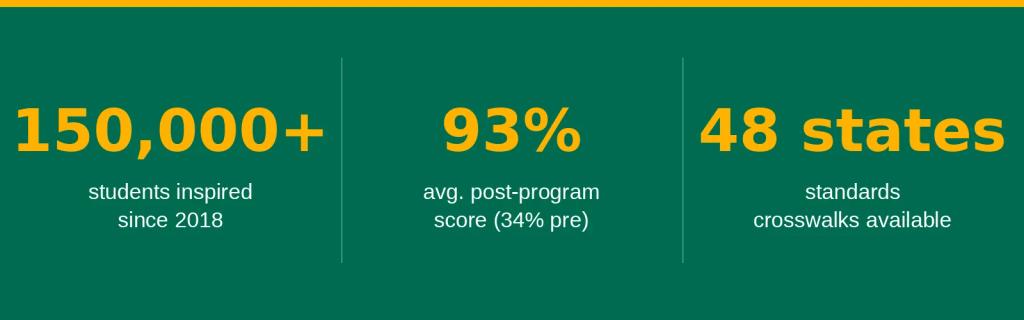
The results hold up: students in Rapunzl's programs move from an average of 34% on financial literacy assessments, below the 64% national average, to 93% afterward, and Rapunzl has reached 150,000+ students and distributed $300,000+ in scholarships since 2018.
Best for: schools with real budget or exploring options for a future budget cycle, looking for a standards-aligned course rather than a one-off program
2. HowTheMarketWorks
Before going any further, it's worth mentioning that HowTheMarketWorks is probably the strongest free option built specifically for middle and high school students.
Teachers create a private contest for their class, set the dates around the actual school calendar, choose the starting balance, and adjust commission rates and other contest rules. Students trade stocks, ETFs, bonds, and mutual funds. There's a built-in lesson library and an Investing 101 course, plus exports of class trading activity and live chat support.
The feature worth stealing regardless of what platform you use: Trade Notes, which requires students to write a justification with every trade. It converts clicking into reasoning and gives you something real to assess.
The catch is the $100,000 starting balance, the same figure The Stock Market Game and Wall Street Survivor also start students with. It's the industry default and it quietly teaches the wrong scale to a 16-year-old.
Best for: a teacher who wants maximum control over a free contest and something structured to assign alongside it.
3. The Stock Market Game (SIFMA Foundation)
The grandparent of the category, run by the SIFMA Foundation, with decades of history and deep ties to state councils on economic education. A lot of teachers played it themselves. So did Rapunzl's founders, who met in high school and competed in it together.
It's often free or heavily subsidized through your state's Council for Economic Education, which many teachers don't realize. It's worth a five-minute email to your local office before you pay for anything because the costs are typically geared towards corporate sponsorships, rather than district budgets.
The trade-off is age. Not much has been updated since those founders played it. Pricing has historically been delayed rather than live, and the interface shows its years.
For a two-week unit that's fine. For a semester it starts to feel dated to students who have a brokerage app in their pocket.
Best for: teachers who want an established, credible program with local affiliate support and don't need live data.
4. Investopedia Stock Simulator
Free, no school affiliation required, and it sits next to the largest finance glossary on the internet, which is legitimately useful when a student asks what a limit order is mid-trade.
But it's built for adult retail investors, not classrooms. There's no real teacher dashboard, no assignment structure, no grade export, and no protections designed around student data. You can run a class in it, but you'll be tracking everything manually in a spreadsheet or supplementing the course with EVERFI and NGPF curriculum resources.
Best for: an after-school investing club, an independent study, or a single motivated student. Not a full class.
5. MarketWatch Virtual Stock Exchange
Free, no school affiliation required, and the fastest setup here. You name a game, set the dates, pick the starting cash, decide whether short selling and margin are allowed, and send students a join link. Ten minutes, no procurement conversation, nobody to email.
It's good at what it is, and it's a trading game attached to a financial news site, which does more teaching than anyone intends. Around the trade ticket, students see a page built for urgency: what's moving, who's up, what to watch today. It frames the market as a scoreboard, the exact instinct a first investing unit should be complicating.
The other gaps are practical. There's no curriculum and no lesson library, so anything assignable you build yourself. And the game is the record, so when it ends, the artifact ends with it.
If you need something to point at in June, or something an administrator can read, this isn't it. A simulator built for a classroom keeps the trail.
One rule repairs most of the damage: cap position size, or borrow the Trade Notes idea from HowTheMarketWorks and require a one-sentence rationale with every trade. Left alone, students work out within days that the fastest way up a two-week leaderboard is one concentrated bet on the most volatile thing available. They're not wrong. That's the flaw in short contests generally, not in this one.
Best for: a one-week competitive burst, an investing club, or the odd week before a break, when you want energy rather than evidence.
6. Wall Street Survivor
The gentlest on-ramp in the category. Registration is free, students get a $100,000 virtual account, and they can trade stocks, ETFs, options, crypto and forex inside invite-only contests you customize down to whether margin and day trading are allowed. The courses are short and beginner-friendly, and students who find a candlestick chart intimidating often warm up faster here than anywhere else.
Two things don't show up in the reviews.
The first is that your list of independent free options is shorter than it looks. Wall Street Survivor is a Stock-Trak property, per Stock-Trak's own site, and so are HowTheMarketWorks, PersonalFinanceLab, and Stock-Trak's own university platform. Three entries on this list trace back to one company.
That's not a scandal; Stock-Trak has been at this since before your students were born. But if you're piloting two tools this fall, pick them from two vendors.
The second is monetization. Wall Street Survivor is aimed at retail adults and pays for itself the way consumer finance sites do: brokerage referral offers, sign-up-bonus promotions, and ranked stock-newsletter reviews sitting a scroll away from the game.
Unremarkable for an adult browsing on their own time. A different proposition for a 16-year-old on a school Chromebook, one click from a real-money brokerage offer, in a class period you're responsible for. Open the pages your students will land on before you assign it.
One more thing: Wall Street Survivor's own disclaimer puts quote data at least 15 minutes behind. Fine for a multi-week contest, not fine if the point of Tuesday is watching a number move. Classroom management is thin by design; the school-facing product in this family is HowTheMarketWorks.
Best for: an individual student easing in, or a differentiated option for kids who need a gentler start, once you've previewed the page.
How the 6 free stock market games compare at a glance
With all six covered, here's how the five free options and Rapunzl actually stack up on the questions that matter for a classroom: whether the data is real, whether there's a built-in classroom mode, who it's built for, and whether it works on a phone. Rapunzl is the only platform in this comparison running live streaming market data instead of a 15-to-20-minute delay, and the only one built specifically for grades 6 through 12.
| Platform | Free tier | Real-time data | Classroom mode | Age range | Mobile app |
|---|---|---|---|---|---|
| HowTheMarketWorks | Free (ad-supported) | 15-20 min delayed | Teacher-run contests, 30+ settings | Middle & high school | Mobile-optimized web, no dedicated app |
| The Stock Market Game (SIFMA) | Little to no cost (free in most states) | ~15-20 min delayed display; a separate Real-Time mode executes trades at time of entry | Team-based classroom contests | Grades 4-12 | Companion app (second screen only, requires an active desktop session) |
| Investopedia Stock Simulator | Free | Delayed (not real-time) | No teacher dashboard; built for individuals | General public / adults | No dedicated app confirmed |
| MarketWatch Virtual Stock Exchange | Free, no school affiliation required | Confirm with vendor | Teacher-created contest (dates, cash, margin/short-selling toggles); no gradebook | Confirm with vendor | Confirm with vendor |
| Wall Street Survivor | Free registration | At least 15 min delayed (per its own disclaimer) | Invite-only, customizable contests; no dedicated teacher dashboard | Confirm with vendor | Confirm with vendor |
| Rapunzl | Paid school or district license | Live streaming Nasdaq + crypto pricing | Educator Dashboard (grade export, standards crosswalks) | Grades 6-12 | The Rapunzl app |
What is a stock market game, and how does it work?
A stock market game, sometimes called a stock market simulator, is a classroom or self-guided tool where students buy and sell real stocks, ETFs, or crypto with simulated money instead of their own. The practice is called paper trading. Nothing real changes hands, but the prices move with the actual market, so a bad trade or a lucky one still teaches something instead of costing something.
The two terms overlap on purpose. "Game" usually describes a time-boxed classroom contest with a leaderboard; "simulator" usually describes an ongoing portfolio a student manages across a unit or a semester. The classroom-built options below span grade 4 through grade 12, while Investopedia's simulator and Wall Street Survivor are aimed at adult retail investors instead. Rapunzl's simulator is built specifically for grades 6-12, with a standards-aligned course wrapped around it.
The setting that changes what a game actually teaches is pricing speed. A platform running live market data lets a student watch a stock move during third period and connect that swing to whatever caused it. A platform running the industry-standard 15-to-20-minute delay teaches the mechanics of buying and selling without ever letting a student see the market actually move, which is why Rapunzl runs live streaming Nasdaq and crypto pricing instead of a delay.
What's the catch with the $100,000 starting balance?
Most of these free stock market games start students with $100,000 in virtual cash: HowTheMarketWorks (customizable in contests), The Stock Market Game (fixed), and Investopedia's simulator (adjustable in custom games) all confirm that number on their own sites, and Wall Street Survivor does too. It's the industry-standard figure, and it traces back to the earliest classroom stock-market contests decades ago. It is not a bug. But it isn't realistic either.
No real high schooler is depositing six figures into a brokerage account. A $100,000 starting balance quietly teaches a scale that doesn't map to a student's actual life, and teachers who run one of these free simulators sometimes reset the balance manually down to $1,000 or $10,000 before a unit starts, precisely so the gains and losses feel like something a student could actually experience.
Rapunzl starts students with a simulated $10,000 portfolio instead of $100,000, a number closer to what a first paycheck or a summer of saving could plausibly build toward. That's not Rapunzl losing a spec comparison. It's a deliberate choice about what the balance is supposed to teach.
Do these free stock market games work on Chromebooks and phones?
Yes on a Chromebook. Every one of these five free games runs in a standard browser, so a district-managed Chromebook handles any of them without extra software. Phones are a different story.
Of the free games we could verify, only the SIFMA Stock Market Game ships a companion mobile app, and it's a second screen for trades already placed on the desktop site: students still have to log into an active game session created on a computer before the app does anything useful. HowTheMarketWorks runs a mobile-optimized website instead of a dedicated app, and Investopedia does not currently offer a simulator-specific mobile app — confirm current availability on Google Play before assigning it for phone use.
Rapunzl's simulator runs natively in the Rapunzl app, so students can check a live portfolio, review a trade, or catch a market move between classes without waiting on a desktop session first.
Sources
- The Stock Market Game — SIFMA Foundation (2026)
- HowTheMarketWorks (2026)
- Wall Street Survivor (2026)
- Stock-Trak (2026)
- PersonalFinanceLab (2026)
Frequently Asked
Questions
For most classrooms, HowTheMarketWorks, because it was designed for schools and gives teachers real contest controls, assignable lessons, and activity exports. The Stock Market Game is the strongest alternative, especially where your state council subsidizes it.
It varies. Several use real-time or near-real-time data; The Stock Market Game has historically run on delayed pricing. If live data matters to your lesson, confirm it with the vendor before the semester starts.
On its own, usually not. A simulation is an activity, not a standards-aligned course. You would pair it with a curriculum and document the standards coverage yourself.
No, and please don't. The entire point of simulation is that students can make a bad call in October and learn from it instead of losing money they need.
Most teachers budget 10 to 15 minutes a couple of times a week for portfolio check-ins, plus a longer session at the start and a reflection at the end. It works as a running thread through a unit rather than a block of consecutive days.
Three of the five: HowTheMarketWorks, PersonalFinanceLab, and Wall Street Survivor are all Stock-Trak properties. That's not disqualifying (Stock-Trak has decades of classroom experience), but if you're piloting two tools this fall, pick them from two different vendors so you're actually comparing approaches.
Most free games default to $100,000, an industry-standard number no student will realistically invest. Several teachers manually lower it to $1,000 to $10,000 to make gains and losses feel real. Rapunzl's simulator starts students at a fixed $10,000 for the same reason.
Yes, but it's a companion app, not a standalone one. Students must already be registered in an active Stock Market Game session created on the desktop site; the app then shows account summary, pending trades, and lets them place trades on the go.
Often, yes. Several of these platforms require email verification, and some school IT filters block the verification email from ever arriving. Test the signup flow with one student account before rolling it out to a full class.
Want to see what live-data investing looks like next to a free contest? Start a free Rapunzl teacher demo account and compare them side by side before you commit your semester.
By Nate Thomas, School Partnerships Lead at Rapunzl and former classroom teacher.