



















Comparing the Top 6 Financial Literacy Curriculums for 2026
Most curriculum roundups rank the best personal finance curriculum for high school and declare a winner. This one takes a different route, because after enough conversations with teachers, one pattern keeps showing up: the program that transformed one classroom sits untouched in another.
- A free module library that saves a veteran business teacher hours of prep can bore a room of ninth graders straight into their phones.
- A fully scripted video course that rescues a first-year advisory teacher can feel like a straitjacket to someone who loves building lessons from scratch.
How we compared these curriculums
Every program in this piece is measured against the same rubric instead of a single "best" score: cost model, standards alignment, teacher lift, whether a live or hands-on component exists, and grade range. That is what makes a fair comparison possible across six very different products.
There is also a deeper split worth naming before any program names come up. Some curriculums are engineered to get students past a financial literacy test. Others are built to develop real financial habits and a durable understanding of personal finance. Both kinds have a place in schools, and the sections below sort out which curriculum matches which kind of classroom.
Rapunzl is scored on that same rubric as everyone else here: cost model, standards alignment, teacher lift, and whether students build habits or just pass a test, using the same 3-week-to-28-week course range and Educator Dashboard crosswalks referenced throughout this piece.
Financial literacy curriculum comparison at a glance
This table lines up the same six comparison points across all six curriculums, so a busy reviewer can check for fit before reading the full write-up on each platform below. Every cell traces to a vendor's own materials; anything unconfirmed reads "confirm with vendor" rather than a guess.
| Curriculum | Cost model | Grade band | Standards-aligned | Simulator / hands-on component | Language options | Teacher lift |
|---|---|---|---|---|---|---|
| NGPF | Free, nonprofit | 6-12 | Yes, national standards (state crosswalk tool: confirm with vendor) | No live simulator; fictional holdings, no real market data | English + Spanish (231+ translated resources) | High, build your own semester from the library |
| EVERFI | Free, sponsor-funded | K-12 | Yes, Jump$tart + CEE National Standards | Confirm with vendor | English + Spanish | Low, self-paced modules, minimal setup |
| Rapunzl | Paid school or district license | 6-12 | Yes, state standards crosswalks in the Educator Dashboard | Yes, real-time, live Nasdaq pricing on a simulated $10,000 stock and crypto portfolio | English + Spanish | Medium, curriculum is built; the live simulator adds active facilitation |
| Ramsey Education | Paid, custom district quote | High school + college | Yes, state-specific alignment pages | Confirm with vendor | English + Spanish (4th edition only) | Low, turnkey and scripted, ready on day one |
| PersonalFinanceLab | Paid school or district license | K-12 | Yes, state-specific alignment pages (e.g., Pennsylvania) | Yes, real-time during U.S. market hours (non-U.S. exchanges 15-20 min delayed) | Confirm with vendor | Medium, customizable platform, no bundled curriculum |
| Junior Achievement | Free/low-cost, sponsor and volunteer funded | Varies by program, 7-12 across offerings | Yes, state standards, Common Core, Jump$tart, NCSS | Yes, accelerated simulation (60 real seconds equals one trading day) | Spanish for select programs only, not the full suite | Medium, coordinated with a volunteer and an educator |
For the experienced teacher who loves to build: NGPF
Next Gen Personal Finance has the deepest free library in the field, full stop. Thousands of lessons, activities, projects, and games built by former teachers, covering everything from paycheck math to niche topics no other provider bothers with. If a personal finance question exists, NGPF probably has an activity for it.
The trade-off is assembly. In many ways, NGPF is like IKEA: you can build anything, but you're going to have to roll up your sleeves.
NGPF hands you the raw materials, not the finished course, and turning that library into a coherent semester takes real planning time and (importantly) enough subject confidence to know what belongs where. Teachers new to personal finance often underestimate that burden until October arrives and scramble to find more pre-built options.
On the test-versus-habits question, NGPF sits in the middle. Its best activities are genuinely hands-on, but the library itself does not offer immersive simulations, real-world learning opportunities, or digital tie-in's. Plenty of NGPF classrooms solve that by pairing the free library with a live investment simulator, which is one of the most sensible combinations in this entire comparison. For a head-to-head, read Rapunzl vs. NGPF.
For the district that needs coverage at scale by Friday: EVERFI
Credit where it is due: when EVERFI launched, very little personal finance curriculum existed, and it pioneered the model where banks and corporations sponsor modules so schools pay nothing. That model still works. If a district needs every junior covered this semester, at no cost, with almost no teacher lift, EVERFI delivers that faster than anyone on this list.
The weakness is what happens inside the modules. The experience is largely passive; students click through screens, read handouts, and fill in worksheets. It is the clearest example of pass-the-test design in this comparison: standards get documented, boxes get checked, and very few habits get built.
A skilled teacher can layer discussion and real-world practice on top, but the platform will not do it alone, and districts who adopt EVERFI in the first year of a requirement will often look to upgrade or supplement the course in the second year of implementation.
For students who need to live it, not just study it: Rapunzl
The most student-centric, engaging option on the list is Rapunzl. Students manage a simulated $10,000 portfolio of stocks and crypto priced with live data from Nasdaq. When markets drop on a Tuesday, their portfolios drop with them, and they have to decide what to do about it. That is the actual skill: living through volatility, reading real news because it affects their positions, and owning decisions with visible results.
Around the simulator sits an integrated, standards-aligned curriculum that scales from a 3-week unit to a 28-week year-long course in English and Spanish, an Educator Dashboard with grade export and state standards crosswalks, and a free national scholarship competition that runs January through late April and gives students real stakes. The platform allows students to access:
- Up to date company financials taken directly from SEC filings via SEC EDGAR
- Real economic indicators charted over 50+ year historical time periods from the Federal Reserve's own economic data
- AI Analysis of company's charts and previous price action
- Dollar-cost averaging simulator to visualize investing in a low-cost index fund over decades
- Much, much more...
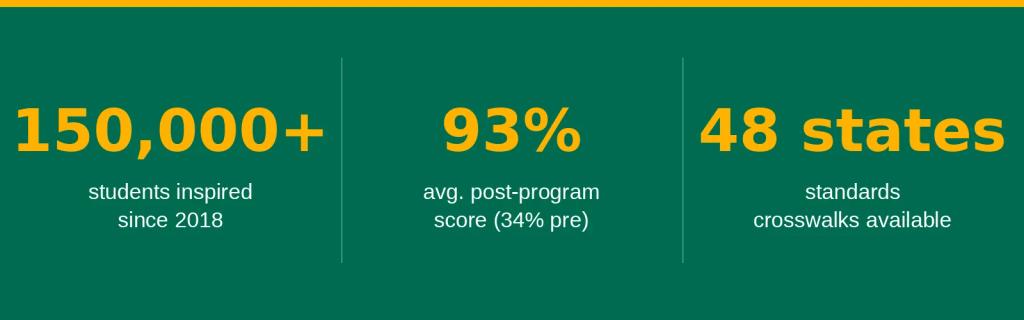
Rapunzl's outcomes back up the approach. Students enter Rapunzl programs averaging 34% on financial literacy assessments and leave averaging 93%. Honest caveat: unlike the free libraries above, there is a cost, and a teacher who only wants printable lessons does not need a live simulator.
For the classroom that wants a semester in a box: Ramsey Education
Ramsey's Foundations in Personal Finance is the most turnkey option here: scripted lessons, polished videos, assessments, a strong teacher community, and a decades-long track record in real classrooms. A teacher handed personal finance three weeks before the semester starts can genuinely run this course on day one.
The catch is the philosophy baked into it. Ramsey's approach is faith-based and strongly debt-averse, and that stance complicates college and FAFSA preparation; teachers report awkward moments explaining student loans to seniors after a semester of hearing all debt treated as a mistake. Investing coverage is also cautious and thin by design.
For a values-aligned school that wants structure above all, it fits. For a college-prep classroom, it needs supplementing and some careful framing.
Bring Rapunzl into your classroom
Explore how Rapunzl helps students build real investing and personal finance confidence.
Set Up A Free Demo AccountFor budgeting and trading under one login: PersonalFinanceLab
PersonalFinanceLab occupies a specific niche well: it bundles a stock market simulation with a budgeting game, so students practice spending decisions and portfolio decisions in the same platform. The technology is reliable and the interface is intuitive, but it lacks integrated curriculum that could help students engage deeper.
For a program that wants both simulations without juggling two vendors, it is the natural shortlist item, and it suits settings where students work independently and pull research from outside the platform.
With that said, it's important to know the limits of PersonalFinanceLab before committing. The investing curriculum around the simulation is limited, it costs much more any of the other options on the list, and there is no mobile option. Although many schools have transitioned to phone-free learning environments, allowing students to extend learning beyond the classroom outside of school hours can have benefits. Expect to supplement this curriculum with EVERFI or NGPF.
Does a free curriculum actually save a district money?
Not automatically. Free is not the same as no cost. NGPF and EVERFI charge nothing to license, but that savings shows up somewhere else. NGPF hands teachers a library, not a finished course, so building a coherent semester from it takes real planning time, and a teacher new to personal finance can lose weeks figuring out sequencing. EVERFI trades that setup burden for a lighter one: teachers spend far less prep time, but the tradeoff is a passive experience built around sponsor-funded content, not necessarily what an individual classroom needs.
Paid, integrated options like Rapunzl or Ramsey Education move the cost the other direction. A district pays for a course that's ready to teach on day one, with less teacher assembly required. Junior Achievement's volunteer model shifts cost into coordination time instead: someone on staff has to schedule and manage the volunteers who deliver it.
The honest framing for a committee is to decide whether the district is paying in dollars, in teacher prep hours, or in coordination time. Every option on this list charges one of the three.

For community connection and volunteer energy: Junior Achievement
Junior Achievement is the elder statesman of this list, a nonprofit with enormous reach and a model nobody else replicates, according to Junior Achievement's own site: trained volunteers from the local business community come into the classroom and teach alongside the educator.
For younger grades, career exposure, and schools that want students meeting real professionals, JA is genuinely special, and its scale means there is almost certainly a chapter nearby.
The honest limitation is depth, particularly on investing, where JA's programs stay lighter than a dedicated semester course demands. Unfortunately, the Junior Achievement course will just barely meet most state standards and offers very little to engage students beyond these career opportunity.
The strongest implementations treat JA as the community layer, regardless of technoloyg and curriculum providers. This helps connect the real-world with classroom learning and illuminates career opportunities in finance.
Which financial literacy curriculum has the best outcomes data?
Rapunzl is the only program on this list with a published before-and-after outcomes figure: students enter Rapunzl programs averaging 34% on financial literacy assessments and leave averaging 93%, a jump of 26 to 29 percentage points above the 64% national average. That result, alongside reaching 150,000+ students since 2018, helped Rapunzl earn recognition as a 2022 Yass Prize finalist. See the full outcomes data behind that number.
NGPF, EVERFI, Ramsey Education, PersonalFinanceLab, and Junior Achievement do not publish a comparable third-party outcomes figure. That does not mean their programs do not work, only that a district asking for outcomes data today will find Rapunzl is the one with a number to show.
What is a financial literacy curriculum vendor evaluation checklist?
A vendor evaluation checklist is the set of questions a district review committee should ask before signing on to any financial literacy curriculum, free or paid. Run the same six checks against NGPF, EVERFI, Rapunzl, Ramsey Education, PersonalFinanceLab, and Junior Achievement:
- Standards documentation. Ask for a written crosswalk from your state's standards to specific lessons, not a general "aligned to national standards" claim.
- Cost model transparency. Confirm whether the program is free, sponsor-funded, or paid, and ask what happens if a sponsor pulls funding or a paid contract lapses. No specific figures belong in this checklist; the model matters more than the number.
- Data privacy and COPPA posture. Any platform collecting student accounts should have a clear, public privacy policy, per the FTC's own COPPA guidance.
- PD and onboarding support. A free library with no onboarding can sit unused. Ask what training a teacher gets in week one.
- Multi-language availability. Confirm which languages are supported and whether that coverage extends to the full course or only select modules.
- LMS and SSO integration. Ask specifically whether the platform works with your district's existing Clever, Google Classroom, or LMS setup.
Rapunzl's Educator Dashboard is built to answer three of these in one place: grade export, state standards crosswalks, and a documented cost model with no hidden per-student surprises.
Sources
- SEC EDGAR — full-text filing search (2026)
- Federal Reserve — Monetary Policy (2026)
- Junior Achievement (2026)
- FTC — Children's Privacy / COPPA (2026)
- STOP for Education / Yass Prize Foundation (2026)
Frequently Asked
Questions
The best one for your classroom type. Builders thrive with NGPF, compliance-first districts lean EVERFI, structure-first teachers pick Ramsey, and classrooms fighting an engagement problem tend to get the most from a live simulator with integrated curriculum like Rapunzl.
Usually yes on paper. NGPF, EVERFI, and Intuit can all document standards coverage. Whether students build lasting money habits from modules alone is a different question, which is why so many teachers add a hands-on component.
Rapunzl and PersonalFinanceLab both do. Rapunzl's uses live Nasdaq pricing for stocks and crypto, so portfolios move with the real market during class; PersonalFinanceLab pairs its simulation with a budgeting game.
Very. Pairing a free content library with a live simulator, or a volunteer program like JA with a full semester course, is often stronger than any single platform on its own.
A standards-to-lesson crosswalk, a clear cost model with no hidden per-student fees, data-privacy and COPPA compliance, and onboarding support for teachers. Rapunzl's Educator Dashboard exports grades and maps directly to state standards, the kind of documentation a district review committee typically asks for during procurement.
Not necessarily. NGPF and EVERFI cost nothing to license, but building a coherent semester from a free library takes real teacher prep time, which is its own cost. Paid, integrated options like Rapunzl or Ramsey trade a dollar figure for a course that's ready to teach without that assembly work.
This page matches curriculum type to classroom type instead of naming one winner; a companion piece, best personal finance curriculum for high school, makes a single, direct recommendation for high school specifically. Read that one if you want a straight answer instead of a match.
No. NGPF's free library and Ramsey's scripted course both build real financial knowledge without one. A simulator adds a hands-on, real-stakes layer, useful for engagement and habit-building, but a strong instructor-led curriculum without one can still meet state standards.
Curious whether live-data investing fits your classroom? Start a free Rapunzl teacher demo account and explore the simulator, the 3-week to 28-week curriculum, and the Educator Dashboard before deciding.
By Clarissa Collins, Curriculum Designer at Rapunzl, building standards-aligned financial literacy curriculum for grades 6–12.